Last updated: November 22, 2026
Choosing a payment processor involves more than comparing advertised transaction rates. For U.S. small businesses, the pricing model itself can affect monthly expenses, budgeting, and the ability to understand payment processing statements.
The choice between flat-rate vs interchange-plus pricing comes down to how processing fees are calculated, how much visibility a merchant has into those costs, and the business’s actual transaction profile.
Flat-rate pricing combines processing costs into a relatively predictable transaction fee. Interchange-plus pricing passes through applicable underlying card costs and adds a separately identified processor markup.
But which option is better for your business?
This guide explains how both models work, compares their advantages and disadvantages, and uses practical calculations to show when each one might cost less.
On This Page
Flat-Rate vs. Interchange-Plus Pricing: Quick Answer
Flat-rate pricing can be attractive to businesses that want straightforward fees, simple reporting, and predictable calculations.
Interchange-plus pricing may be worth evaluating when a business wants more visibility into card processing costs, has a favorable transaction mix, or can obtain competitive processor markup.
Neither pricing model is automatically the cheapest.
The best option depends on monthly sales, transaction count, average purchase size, card types, payment channels, and additional account fees.
What Is Flat-Rate Credit Card Processing?
Flat-rate processing uses a published percentage and, in many cases, a fixed fee for each transaction.
For example, imagine a provider charges:
2.9% + $0.30 per transaction
Under this illustrative pricing structure, a $100 payment would cost:
- Percentage fee: $2.90
- Fixed transaction fee: $0.30
- Total processing fee: $3.20
The same pricing formula generally applies to transactions covered by that particular rate category.
However, a processor may publish different flat rates for in-person payments, online transactions, manually entered cards, and international transactions.
Advantages of Flat-Rate Pricing
- Simple fee calculations
- Easier budgeting
- Less complicated statements
- Convenient for businesses with limited administrative resources
- Often available through integrated payment platforms
Disadvantages of Flat-Rate Pricing
- The bundled rate may not reflect savings from lower-cost card transactions
- Fixed fees can be expensive for small purchases
- The provider’s underlying markup is not always separately visible
- Additional charges may still apply
Flat-rate pricing prioritizes simplicity, but simplicity does not guarantee the lowest overall cost.
What Is Interchange-Plus Pricing?
Interchange-plus pricing separates underlying card processing costs from the processor’s markup.
Its major components generally include:
- Interchange fees: Charges associated with the transaction and the cardholder’s issuing bank.
- Network fees: Fees charged under applicable card network schedules.
- Processor markup: The additional percentage and/or fixed amount charged by the payment processor.
A processor might advertise its markup as:
Interchange + 0.30% + $0.10
This does not mean the total transaction costs only 0.30% + $0.10. Applicable interchange and network charges are additional.
Different cards and transaction types may produce different underlying costs.
Advantages of Interchange-Plus Pricing
- Greater visibility into underlying processing charges
- Separately identified processor markup
- Potential cost benefits for businesses with lower-cost card transactions
- Opportunities to compare or negotiate processor markup
- Detailed transaction cost reporting
Disadvantages of Interchange-Plus Pricing
- More complicated statements
- Less predictable effective transaction rates
- Card mix can change monthly costs
- Additional processor fees may offset apparent savings
- Comparing quotes requires more detailed information
Interchange-plus pricing provides more cost detail, but businesses still need to understand the full merchant agreement.
Want to understand the broader costs of accepting card payments? Read our complete guide to credit card processing fees for small businesses, including published rates, hidden charges, and practical cost examples.
Flat-Rate vs. Interchange-Plus: Side-by-Side Comparison
| Feature | Flat-Rate | Interchange-Plus |
|---|---|---|
| Pricing structure | Bundled percentage and fixed fee | Underlying card costs plus processor markup |
| Predictability | Generally higher | Varies with card mix |
| Fee transparency | Simpler, less itemized | More detailed |
| Ease of budgeting | Easier | Requires more analysis |
| Processor markup | Often bundled | Usually separately identified |
| Best fit | Businesses prioritizing simplicity | Businesses evaluating detailed transaction costs |
| Guaranteed cheapest? | No | No |
These are general characteristics. Individual provider agreements can differ significantly.
Realistic Cost Comparison: $20,000 in Monthly Sales
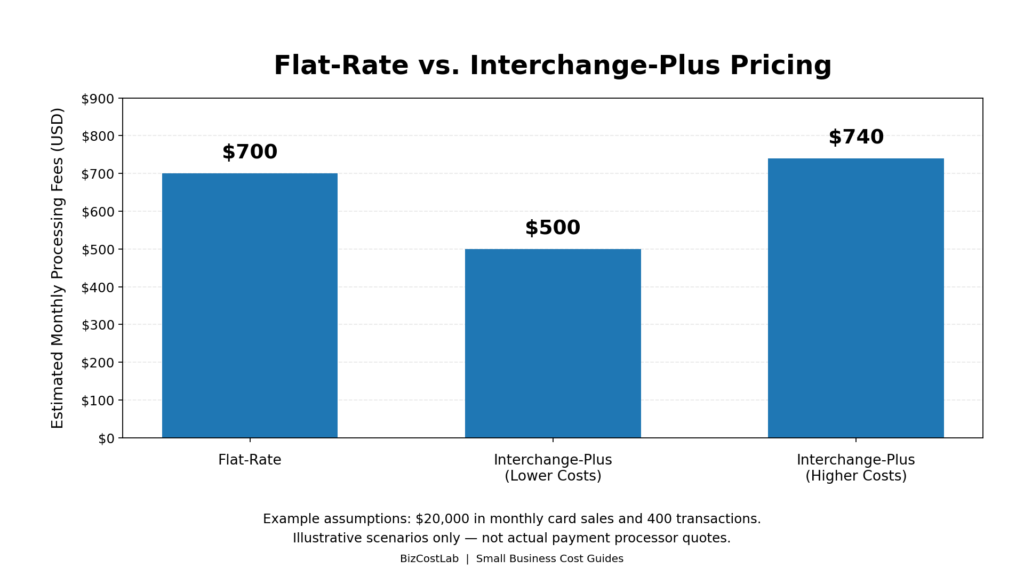
To illustrate the difference, consider a small business with the following monthly activity:
- Monthly card sales: $20,000
- Monthly transactions: 400
- Average transaction amount: $50
We will compare two hypothetical payment processing arrangements.
Important: The rates below are illustrative assumptions, not current merchant offers or quoted interchange rates.
Scenario 1: Flat-Rate Processing
Assume the processor charges:
2.9% + $0.30 per transaction
Percentage fees:
$20,000 × 2.9% = $580
Fixed transaction fees:
400 × $0.30 = $120
Total estimated monthly fees: $700
Estimated effective rate:
$700 ÷ $20,000 × 100 = 3.50%
If monthly activity stays constant, estimated annual processing fees would be $8,400.
Scenario 2: Interchange-Plus With Lower Underlying Card Costs
Now assume the same sales volume and transaction count, but a different pricing arrangement.
For this hypothetical example, assume:
- Blended underlying interchange and network costs: 1.7% + $0.10 per transaction
- Processor markup: 0.3% + $0.10 per transaction
- Monthly account fee: $20
Underlying percentage costs:
$20,000 × 1.7% = $340
Underlying fixed costs:
400 × $0.10 = $40
Processor percentage markup:
$20,000 × 0.3% = $60
Processor fixed markup:
400 × $0.10 = $40
Monthly account fee: $20
Total estimated monthly fees: $500
Estimated effective rate: 2.50%
In this scenario, interchange-plus costs $200 less per month than the illustrative flat-rate offer.
That would equal $2,400 over 12 months if the same assumptions continued.
Scenario 3: Interchange-Plus With Higher Underlying Card Costs
The outcome can change when the underlying transaction costs are higher.
Keep the same sales volume, processor markup, and monthly fee, but assume blended underlying costs of:
2.8% + $0.15 per transaction
Underlying costs:
($20,000 × 2.8%) + (400 × $0.15) = $620
Processor markup:
($20,000 × 0.3%) + (400 × $0.10) = $100
Monthly account fee: $20
Total estimated monthly fees: $740
Estimated effective rate: 3.70%
In this scenario, interchange-plus costs $40 more per month than the flat-rate example.
What These Examples Show
| Scenario | Monthly fees | Effective rate |
|---|---|---|
| Flat-rate | $700 | 3.50% |
| Interchange-plus, lower underlying costs | $500 | 2.50% |
| Interchange-plus, higher underlying costs | $740 | 3.70% |
The results depend on the assumptions.
Actual interchange and network costs vary, and merchants should use their own processing data rather than relying on generalized examples.
What Determines Which Pricing Model Costs Less?
Several factors can materially affect the comparison.
Monthly Processing Volume
Larger sales volumes can make small differences in percentage-based charges more important.
For example, a difference of 0.20 percentage points on $100,000 in monthly card sales represents $200 before fixed or additional fees.
However, high volume alone does not establish which model will win.
Average Transaction Size
A fixed fee per transaction has a larger percentage impact on smaller purchases.
A business processing 1,000 transactions of $10 may face a different cost structure from a business processing 100 transactions of $100, even when total card sales are equal.
Debit vs. Credit Cards
Different card types can qualify for different underlying interchange categories.
Businesses with a larger share of eligible lower-cost debit transactions may want to investigate how interchange-plus pricing treats those payments.
In-Person vs. Online Payments
Card-present and card-not-present transactions can have different risk characteristics and fee schedules.
A business accepting most payments through an online checkout should compare offers for online processing specifically.
Additional Monthly Charges
A lower transaction markup may be offset by account fees, monthly minimums, gateway charges, or required subscriptions.
Compare the complete cost, not just the headline rate.
When Does Flat-Rate Pricing Make Sense?
Flat-rate pricing is worth considering when:
- Your business processes a relatively modest volume of card sales.
- You prefer simple calculations and reporting.
- You want an integrated checkout or POS solution.
- Your transaction mix is relatively stable.
- You want to avoid the administrative work of reviewing detailed interchange categories.
These considerations do not mean a small business should automatically choose flat-rate pricing.
A competitive interchange-plus offer could still be attractive.
When Does Interchange-Plus Pricing Make Sense?
Interchange-plus pricing is worth investigating when:
- Your business has substantial recurring monthly processing activity.
- You want to understand how much you pay in underlying card costs.
- You can compare multiple processor quotes.
- Your card mix includes transactions that may qualify for lower underlying costs.
- You are comfortable reviewing more detailed monthly statements.
The processor’s markup, network fees, account charges, and transaction mix should all be included in the comparison.
Additional Fees to Compare Before Choosing a Processor
Before signing a merchant agreement, ask about:
- Monthly account fees
- Gateway or software subscription fees
- PCI-related charges
- Chargeback and dispute fees
- Monthly minimums
- Batch or settlement fees
- International card surcharges
- Currency conversion charges
- Equipment costs
- Early termination fees
Not every provider charges these fees, and some may include certain services within other charges.
Ask for a complete written pricing schedule.
How to Compare Two Processing Quotes Correctly
Use the following process to make a more meaningful comparison.
Step 1: Gather Your Payment Data
Collect at least one recent monthly processing statement, ideally several.
Identify total card sales, transaction count, average ticket size, and the share of in-person versus online payments.
Step 2: Request a Full Pricing Breakdown
Ask each provider for the applicable transaction rates, network charges, markup, subscriptions, and other fees.
Step 3: Use the Same Sales Assumptions
Compare providers using identical monthly volume, transaction count, and payment method assumptions.
Otherwise, the comparison may be misleading.
Step 4: Calculate the Effective Rate
Use this formula:
Effective rate = Total processing fees ÷ Total card sales × 100
This provides a useful summary of the overall cost.
Step 5: Check Non-Price Factors
Also consider settlement timing, support, fraud prevention, POS compatibility, reporting, and contractual flexibility.
The cheapest payment processor is not necessarily the most suitable provider for every business.
Estimate Your Payment Processing Costs With BizCostLab
The free Payment Processing Fee Calculator from BizCostLab can help estimate processing expenses using:
- Monthly card sales
- Number of transactions
- Percentage-based fees
- Fixed transaction fees
- Additional monthly fees
You can use it to model a flat-rate offer or an estimated blended rate for another pricing arrangement.
However, the calculator does not independently calculate every interchange category or network assessment. For an accurate interchange-plus comparison, use detailed provider statements or a quote based on your actual card mix.
Frequently Asked Questions
Is interchange-plus always cheaper than flat-rate pricing?
No. Interchange-plus may cost less when the underlying card costs and processor markup are favorable, but higher underlying fees or additional charges can make it more expensive.
Is flat-rate pricing better for small businesses?
It can be attractive because of its simplicity, but the best option depends on sales volume, payment channels, and the full pricing agreement.
What does interchange-plus 0.30% + $0.10 mean?
It generally describes the processor’s additional markup. Applicable underlying interchange and network fees are charged separately.
Can a business switch from flat-rate to interchange-plus?
Possibly. Availability depends on the payment provider, merchant agreement, business eligibility, and supported processing arrangements.
How can I compare actual processing costs?
Calculate your effective processing rate using total fees divided by total card sales. Then compare complete provider offers using the same transaction data.
Final Verdict: Which Pricing Model Is Better?
Flat-rate and interchange-plus pricing solve different merchant needs.
Flat-rate pricing offers simpler calculations and can make budgeting easier.
Interchange-plus pricing provides more detailed cost visibility and can be attractive when the underlying transaction costs and processor markup are favorable.
The best decision is to compare both structures using your own sales volume, average transaction size, card mix, and full account fees.
Do not select a processor based only on its advertised percentage. Compare the total cost of accepting payments.
Official Sources and Further Reading
- Stripe — Credit Card Terminal Rates Explained
- Stripe — Cheapest Ways to Accept Credit Card Payments
- Helcim — U.S. Fee Disclosures
- Square — Processing Pricing
- Visa — Interchange and Processing Fees
Editorial note: This article was prepared for U.S. small businesses and reviewed against official payment industry information in November 2026. The numerical comparison scenarios are illustrative rather than real merchant quotes. Actual charges and provider terms may differ.