Last updated: November 22, 2026
Credit card processing fees are an important operating expense for small businesses in the United States. Whether you run a retail store, restaurant, service business, or online shop, accepting card payments usually comes with transaction costs.
The challenge is that processing fees are not always straightforward. Different providers use different pricing models, and the amount you pay can depend on your sales volume, average transaction size, payment method, and merchant agreement.
This guide explains how credit card processing fees work, compares published pricing examples, and shows how to estimate your monthly and annual expenses.
On This Page
What Are Credit Card Processing Fees?
Credit card processing fees are charges associated with accepting and processing card payments.
A merchant generally pays these charges to its payment provider or acquiring institution. The provider’s pricing may reflect several underlying components:
- Interchange fees: Fees transferred between financial institutions involved in card transactions.
- Network fees: Charges associated with payment card networks.
- Processor markup: The amount charged by the payment provider for its services.
- Additional fees: Potential charges for subscriptions, disputes, international transactions, or optional services.
A business may see one combined fee or several separately itemized charges.
Understanding the pricing structure makes it easier to compare providers.
Credit Card Processing Rates in 2026: Real Pricing Examples
Several major payment providers publish standard rates for U.S. merchants.
The following examples were checked against official provider pricing information in November 2026.
| Provider and payment type | Published rate |
|---|---|
| Square Free — in-person payments | 2.6% + $0.15 |
| Square Free — online payments | 3.3% + $0.30 |
| Stripe — domestic online cards | 2.9% + $0.30 |
| PayPal Checkout — domestic transactions | 3.49% + $0.49 |
These are examples of specific services, not equivalent quotes for identical payment methods. PayPal Checkout, for example, is a different checkout product from standard direct card processing.
Rates may change or vary with merchant plans, transaction types, currency, and additional fees.
Official pricing sources:
Always confirm the terms applicable to your business before making a purchasing decision.
How to Calculate Credit Card Processing Fees
For a basic flat-rate pricing model, you can estimate monthly processing costs using this formula:
Monthly processing fees = (Monthly card sales × Percentage rate) + (Number of transactions × Fixed fee) + Monthly account fees
Example: $10,000 in Monthly Card Sales
Consider a small online business with these assumptions:
- Monthly card sales: $10,000
- Number of card transactions: 200
- Average transaction amount: $50
- Processing rate: 2.9% + $0.30
- Additional monthly account fees: $0
The calculation is:
Percentage fee: $10,000 × 2.9% = $290
Transaction fee: 200 × $0.30 = $60
Total estimated monthly processing fees: $350
If monthly activity remains unchanged:
Estimated annual processing fees: $4,200
The business’s effective processing rate would be:
$350 ÷ $10,000 × 100 = 3.50%
The effective rate includes the percentage-based and fixed transaction charges.
This example excludes disputes, international card fees, currency conversion, taxes, and other possible charges.
Flat-Rate vs. Interchange-Plus Pricing
Payment processors use different pricing structures.
Flat-Rate Pricing
Flat-rate pricing usually combines a percentage of each transaction with a fixed fee.
For example, a provider might charge 2.9% + $0.30 per eligible online payment.
This structure is relatively simple to estimate, although extra charges may still apply.
Interchange-Plus Pricing
Interchange-plus pricing generally passes through applicable interchange charges and adds an agreed processor markup. Network charges and other fees may be listed separately.
Because interchange costs can vary by transaction, the final effective rate may also vary.
A merchant should request the exact markup, transaction fees, account fees, and treatment of network costs before comparing quotes.
Tiered Pricing
Some providers classify transactions into pricing tiers, often described as qualified, mid-qualified, and non-qualified.
The rules determining these categories can make the final cost more difficult to predict.
When evaluating a tiered offer, request examples using your expected transaction types.
Hidden Credit Card Processing Costs to Watch
The advertised transaction rate may not represent the complete cost of accepting payments.
Potential additional expenses include:
- Monthly account or service fees
- Payment gateway subscriptions
- Chargeback or dispute fees
- International card charges
- Currency conversion fees
- Optional fraud prevention services
- Payment terminal or equipment charges
- PCI-related service or noncompliance fees, where applicable
- Contract cancellation fees, where permitted and applicable
Not every provider charges every fee.
Review the merchant agreement and request an itemized pricing schedule.
Does Transaction Size Affect Processing Costs?
Yes. Fixed per-transaction fees can have a greater impact when a business processes many small purchases.
For example, consider a $10 sale processed at 2.9% + $0.30.
Percentage component: $0.29
Fixed component: $0.30
Total transaction fee: $0.59
That represents an effective rate of 5.9% on the $10 transaction.
For a $100 sale at the same rate:
Percentage component: $2.90
Fixed component: $0.30
Total transaction fee: $3.20
That represents an effective rate of 3.2%.
These examples show why average ticket size matters when evaluating payment processing costs.
How to Reduce Credit Card Processing Fees
Small businesses can take several practical steps to manage processing expenses.
Compare Complete Pricing
Look beyond the advertised percentage rate. Include fixed transaction costs, subscriptions, and optional fees.
Review Monthly Statements
Track total processing charges against card sales to identify your actual effective rate.
Ask About Custom Pricing
Some providers may offer negotiated pricing to eligible businesses with higher processing volumes.
Avoid Unnecessary Services
Review optional subscriptions and features to confirm that they provide enough value to justify their cost.
Compare Payment Methods
Different payment methods may have different cost structures. Evaluate the fees alongside customer preferences, operational requirements, and fraud considerations.
Understanding credit card processing fees starts with reviewing your actual payment statements. Small businesses should compare credit card processing fees across providers using their average transaction size, monthly payment volume, and additional account charges. Tracking these expenses regularly can reveal opportunities to reduce unnecessary costs.
Estimate Fees With the BizCostLab Calculator
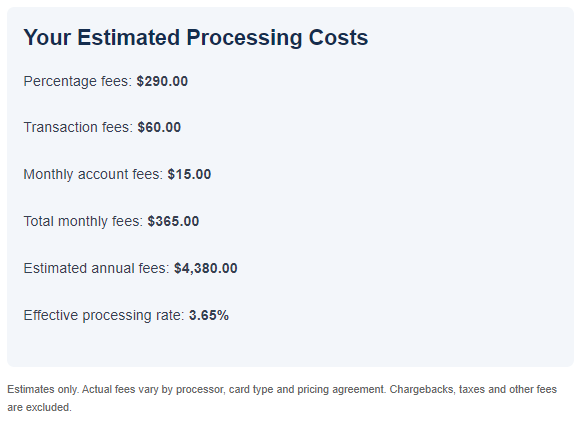
Instead of calculating every transaction manually, you can use the free Payment Processing Fee Calculator from BizCostLab.
The calculator lets you enter:
- Monthly card sales volume
- Monthly number of transactions
- Processing percentage
- Fixed fee per transaction
- Additional monthly account fees
It then estimates monthly processing expenses, annual fees, and the effective processing rate.
These calculations are educational estimates and do not replace an actual merchant statement or provider quote.
Frequently Asked Questions
What is a credit card processing fee?
It is a charge associated with processing a card payment, typically paid by a merchant to its payment service provider or acquiring institution.
Are processing fees the same for online and in-person payments?
Not necessarily. Providers may publish different rates depending on whether a card is presented physically, entered manually, or used online.
What is an effective processing rate?
The effective processing rate is the total processing cost divided by the total card sales volume, expressed as a percentage.
Can small businesses negotiate processing fees?
Some providers offer custom pricing to eligible businesses. Availability depends on the provider and merchant circumstances.
Are all processing fees included in the advertised transaction rate?
No. Depending on the service and agreement, additional charges may apply.
Final Thoughts
Credit card processing fees can have a significant impact on a small business’s operating expenses.
The most useful comparison is not simply which provider advertises the lowest percentage, but which option offers the best overall cost and capabilities for a specific business.
Review your transaction volume, average sale size, processing channels, and potential additional charges before selecting a provider.
Use the BizCostLab Payment Processing Fee Calculator to test different scenarios and make more informed financial decisions.
Editorial note: Provider rates were reviewed against official U.S. pricing pages in November 2026. Rates and terms are subject to change. This article provides educational information and does not constitute financial or contractual advice.